


Kia Ora New Zealand
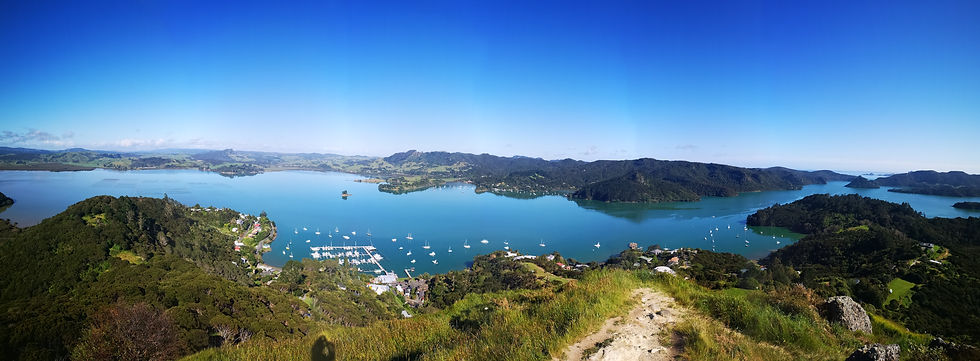
We made it from Fiji to New Zealand!
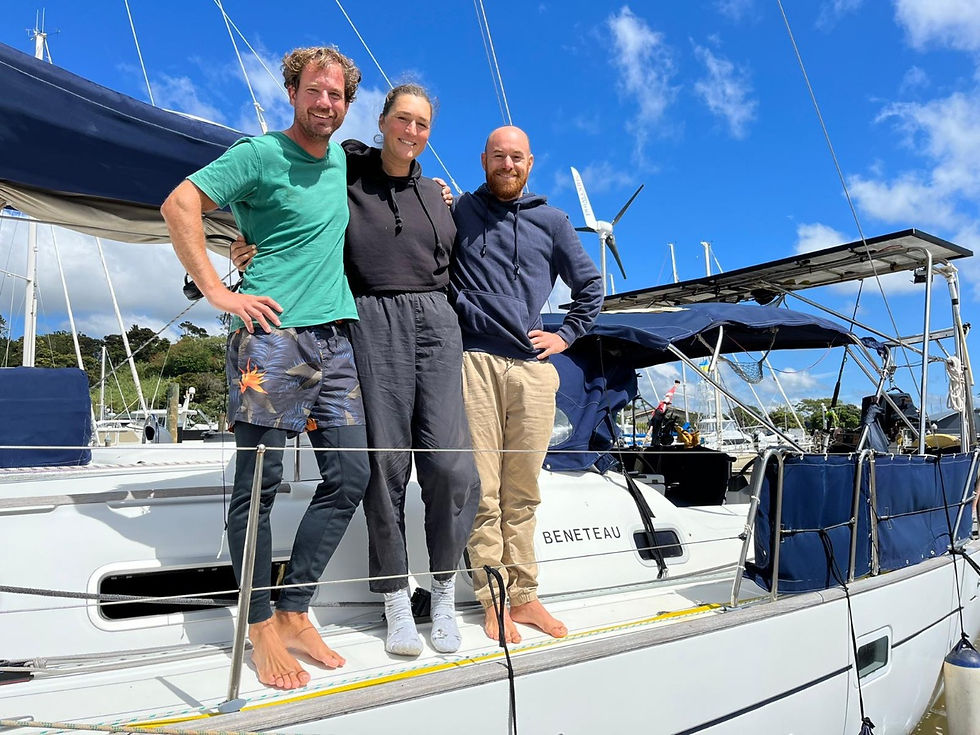
After a voyage of just under seven days, the Yum Yum and its crew—Marc from Switzerland, Christine from Liechtenstein, and me—arrived in Opua, New Zealand.
In the South Pacific, there is an increased risk of cyclones between November and April; in other words, every year a number of severe weather systems sweep across Fiji, some stronger, others weaker. The fact is, however, that no boat owner wants to leave their vessel in Fiji during this time, especially since insurance companies do not provide coverage. The passage from Fiji to New Zealand isn’t exactly popular or the easiest, since it takes you out of the trade wind zone—where constant easterly winds normally blow and make for pleasant sailing. On this passage, you can encounter any kind of weather: comfortable sailing with the wind at your back, heavy-weather sailing, calm conditions, strong headwinds, and/or high waves. For this reason, I’ve been studying weather systems more frequently in recent weeks than I have in the past. The departure must be carefully planned. I quickly realized that there won’t be a perfect weather window for this 7- to 10-day crossing. The high- and low-pressure systems pushing up from the Tasman Sea are simply too unpredictable for that. In addition, the temperature drops with every nautical mile sailed southward; in Fiji, we still had midsummer temperatures above 30 degrees, but New Zealand is expecting us with temperatures between 11 and 17 degrees... brr... After about four years in summery climates, this will hit me hard, and shoes and socks will likely become the order of the day.
So the topic of the “crossing” became the number one topic of conversation among the cruisers, and there was a lot of discussion and speculation about it. In the end, things moved along relatively quickly: on Sunday, October 23, Carolin disembarked because she had a flight to the Philippines; the Yum Yum was made ready for the crossing, the paddleboard and dinghy were stowed, a rig check was performed, meals were prepped, and we cleared customs from Fiji as early as Monday. However, I then postponed the departure again from Tuesday evening to Wednesday morning, October 26, because the wind and, in particular, the forecast waves were too high for me. The plan was to sail for 5–6 days and then spend the last 1–2 days motoring toward New Zealand to arrive ahead of the low-pressure system, which was moving toward our destination and had forecast winds exceeding 35 knots.
And then we were off! Engine on, anchor up, sails up, engine off, and… practically no wind… we were just bobbing along. Sure, we were still sheltered by the main island of Viti Levu, but the forecast had called for 20 knots of wind—some of it had to be getting through. Of course, I was already crunching the numbers again—at this speed, it would take us about 12 days. Since I knew we’d need every liter of diesel at the end of the trip to arrive before the storm, I watched the whole scene for two or three hours, trimming the sails to get the most out of them. And then it finally came—the wind. The Yum Yum raced off like never before in her life—especially not since I’ve been the owner of this wonderful yacht. For the next 750 miles, the water rushed past us at an average of 7.5 knots, even with the sails reefed (the sail area is reduced when there’s too much wind or at night). I was absolutely thrilled by the way the boat cut through the waves; every now and then a splash of water would fly across the cockpit, leaving me soaked from head to toe, but it was wonderful to sail at that speed. There were times when we were cruising at an incredible 9.2 knots.
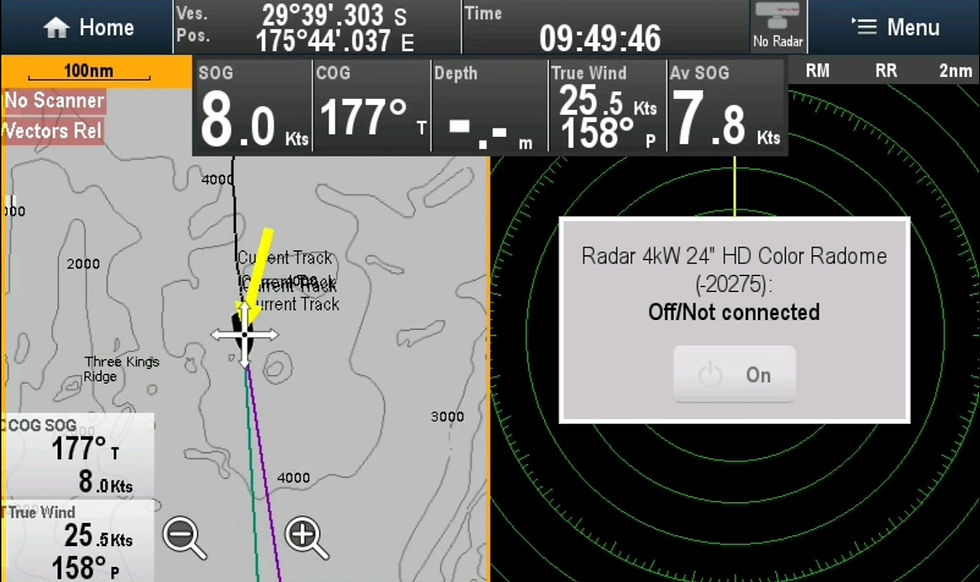
The view on the chartplotter;
Left: the chart showing wind direction and a course arrow
Right: The radar is turned on at night or during thunderstorms
Top: Information about speed, course, wind, and average speed
However, we weren’t alone on the vast ocean; on the same day we set sail, there were surely 20–25 other boats heading for New Zealand. Some larger vessels and catamarans quickly disappeared from view, while others stayed by our side for 1–2 days—at least their AIS signals were visible on the chartplotter. Unfortunately, two boats we were friends with weren’t able to clear customs from Fiji until the day of departure and were consequently a few miles behind us, but we stayed in daily contact via the satellite device, and it was nice to hear how they were doing. After about four and a half wonderful days of sailing, the lull arrived as expected and announced, and unfortunately we had to start the engine. The next 46 hours are quickly told: grrrrr, grrrrr, grrrrr—the engine was running. For the Yum Yum, this number of engine hours was already pushing the upper limit of what was possible, since we don’t have an unlimited supply of diesel.
After 6 days and 17 hours, we tied up at the quarantine dock in Opua, New Zealand, shortly after midnight! Totally happy and exhausted, we fell into bed—which, after six nights, no longer wobbled. The next day, it was time for the official procedures with Customs, Immigration, and Biosecurity. Everything went like clockwork; the officials were super friendly, and after just two hours, we had officially entered New Zealand.
Now it’s time to relax for a few days before we winterize the Yum Yum and I fly back to Switzerland for a few months.
Bula Fiji, Kia Ora New Zealand
P.S.: Fun fact: No sooner had we arrived in safe waters than a low-pressure system with winds of 40 to 50 knots at our anchorage was forecast for the next few days...
Comments