


Back in Fiji: Vanua Levu
Before we really get started, let’s begin with a little geography, history, and general knowledge about Fiji, huh? I promise: It’s really interesting!
Fiji—described by Lonely Planet as a “little-known South Pacific paradise” (huh?)—consists of over 330 islands, about 110 of which are inhabited. The largest are Viti Levu in the south, home to the capital Suva, and Vanua Levu in the north. Fiji’s population is diverse: indigenous Fijians, Indo-Fijians, and smaller groups of Europeans, Chinese, and other Pacific Islanders live here together.
Fiji was colonized by the British in the 19th century, gained independence in 1970, and has been a parliamentary democracy since 2014. Its history has been marked by political upheavals—including several military coups—and ethnic tensions.
The Indo-Fijians are descendants of the indentured laborers who were brought from India to the sugarcane plantations by the British starting in 1879 (a rather euphemistic way of saying “to be exploited”). Today, they make up about 37% of the population and have had a strong influence on Fiji’s culture and economy. Historical tensions between Indian and indigenous Fijians led to political crises and a massive exodus of many Indo-Fijians.
Fiji’s economy is based primarily on tourism (scuba diving, luxury resorts), agriculture (especially sugarcane), and fishing. Culturally, Fiji is a fascinating blend of indigenous and Indian influences: traditional dances, music, and crafts are central parts of everyday life.
A particularly important cultural custom is the so-called Sevusevu—the ritual introduction to the village chief before one is allowed to enter his village. But more on that when the time comes.
The official languages are English, Fijian, and Fijian Hindi. English dominates in government, schools, and administration—but in everyday life, you hear a mix of all of them.
And one more very important point: rugby. Fiji is crazy about rugby, especially when it comes to the rugby sevens team—both the men’s and women’s teams are extremely successful internationally. In their honor, there’s even a 7-Fijian-dollar bill dedicated to each team.
The most important word in Fiji? “Bula”! It mainly means “hello,” but it can actually mean just about anything—as long as it’s positive 🙂. “Vinaka” (thank you) and “Vinaka vaka levu” (thank you very much) are also phrases you should remember if you find yourself, as a Palagi [palangi] (that’s what they call Europeans, Americans, Australians—basically, white people—here), in this South Pacific paradise.
Savusavu – June 18–27, 2025
After 60 hours—or 420 nautical miles—under sail, we finally saw land looming ahead of us: Fiji! Okay, to be honest, we didn’t see anything except the lighthouses marking it, because it was the middle of the night when we reached Fijian waters. We anchored blindly in the dark three miles off the town of Savusavu to get some more sleep before we had to deal with all the bureaucratic red tape. Strictly speaking, it’s strictly forbidden to enter Fijian territory—which includes even simply dropping anchor on the seabed—before you’ve properly cleared customs. It’s a bit like cutting through a border fence on a new moon, dressed in black and armed with hedge clippers, just to then sneak through on the sly. In short: it was illegal to cross a national border without first showing your passport to someone.
But at one in the morning, we wouldn’t have been able to reach anyone anyway, so we just cheekily dropped anchor and treated ourselves to a few hours of sleep. The fact that our AIS was broken at the time—and that, as if by magic, the Yum Yum had vanished from all digital nautical charts—gave the whole thing a slightly criminal touch—hihihi.
The next morning, Mirko and I set off at a leisurely pace for Savusavu, a town of 7,000 people on Vanua Levu, one of Fiji’s two main islands. The town was one of the first stops for sailors in Fiji. We hoisted the yellow quarantine flag and committed today’s date to memory so we could tell the officials our arrival date without hesitation. We—and the Yum Yum—still looked as if we’d spent several days and nights at sea. No one would question our actual arrival time.
After Mirko radioed the marina, we were greeted by a Fijian in a small boat with a friendly “Bulaaaa!!!” who guided us to a buoy in the bay. His name was William, and although he was friendly, he acted as if this were the first time he’d ever helped a yacht crew tie up at a mooring. Normally, you thread the rope—which is attached at one end to the cleat on the boat—through the ring on the buoy and hand the other end back to the sailor at the bow so he or she can secure the rope back on board. William simply tied the very last end of the rope to the buoy with such a clumsy, improvised knot that, if the wind changed direction even slightly, the Yum Yum could either be slashed by the sharp coral or even get snagged in the mangroves. Mirko, who on the surface seemed totally laid-back as always, was not at all happy about William’s incompetence and, under his questioning gaze, immediately took charge of the maneuver himself. Coupled with hunger, his frustration was an explosive mixture brewing just beneath Mirko’s surface.
It was a good thing that the Fijian authorities always took their time, so we were able to grab a bite to eat after William had dashed off to bring the officials in question aboard. The official clearance process usually goes like this: Various officials from the Health Department, Customs, Immigration, and Biosecurity come directly onto the boat, which is marked “In Quarantine” by the yellow flag. Once the inspections of the people, the boat, and the cargo are complete and everyone is satisfied, you get a stamp in your passport and are allowed to stay in Fiji for four months (or, in the case of a floating residence, up to two years).
The first to arrive was the young lady from the Health Department—sniffling and, by her own admission, wearing the wrong shoes. She asked us a few questions about our health and took some blurry photos of our food supplies while constantly blowing her nose.
An hour later, three more Fijians showed up. Mirko, now well-versed in the clearance process, immediately broke the ice with a charming “I remember you from last year,” directed at the customs officer. The lady was flattered and, with that unshakable calm that apparently only true Fijian women possess, examined our passports and scribbled something on her forms. Meanwhile, the man from the immigration office just stared dreamily into the distance and took hardly any part in what was happening on board.
The third member of the trio—the biosecurity guy—simply asked for our trash with sleepy indifference and muttered “Yum Yum…” to himself every now and then, as if he were meditatively processing the boat’s name.
As a sailor, you usually have a lot of respect for biosecurity: Sometimes, the entire boat would be turned upside down in search of illegal (or—depending on the time of day—lunch-worthy) food that had somehow made its way into Fijian waters without authorization. Our friend wasn’t interested in anything at all. Not the onions, not our nuts, and certainly not the contents of our refrigerator. When we met him again in his office a few days later to settle the bill, it finally became clear to us just how little these officials understood about life aboard a yacht. He seriously asked us if we really lived on canned food for months on end—and it was inconceivable to him that we didn’t have a freezer on board.
But back to what was actually happening on board: After about half an hour, all the formalities were taken care of, and we were officially welcomed to Fiji. You’d think that meant we could set sail right away and explore the idyllic island groups—but that’s not quite right. First, you have to wait for the so-called “cruising permit.” And that takes between two and seven days—depending on whether or not a weekend falls in between. Apparently, the paperwork is sent to the main island, Suva, where somewhere a lone Fijian sits behind his desk on an uncomfortable wooden chair, boredly stamping the scraps of paper. The whole process probably still happens the old-fashioned way via mail (or carrier pigeon)—there’s no other way to explain why it always takes so long.
Although we weren’t allowed to travel by boat without the permit, Mirko and I were permitted to begin our exploration of Savusavu on foot. After 19 days at sea—since we set sail from New Zealand—we finally felt solid ground beneath our feet again—wonderful!
Our still-unquenched hunger led us first to a restaurant we already knew: the Planters Club, where we’d enjoyed lunch during our last visit to Fiji. Although the kitchen was undergoing renovations—a woman was sizzling our food in a huge, rusty wok while in the corner a barefoot man wearing sunglasses as safety goggles was welding something together—the food tasted as good as ever: chow mein and stir-fried chicken, served with a fresh coconut to drink. Mmmmmmmmmmmm. And best of all: it was just as affordable as it had been during our last visit to Savusavu less than a year ago.
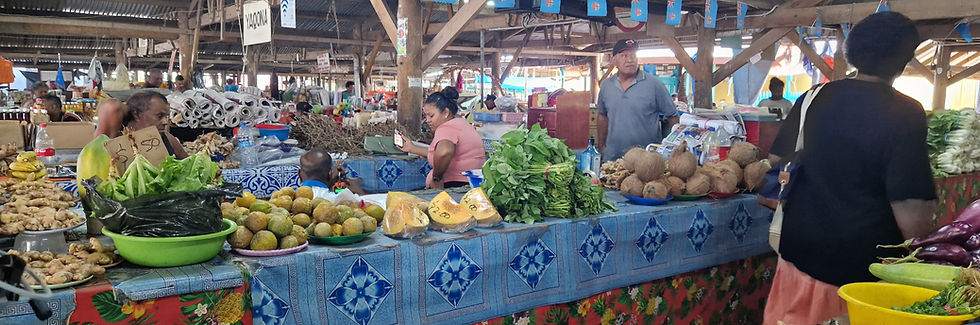
The days in Savusavu, as we waited for those scraps of paper, flew by. Almost every day, we strolled down the one street where the whole life of the town seemed to unfold, went shopping at the various, fairly well-stocked grocery stores, and watched with amusement the strained faces of the Fijians at the market as they tried to figure out our haggling over the prices of fruits and vegetables. Although the market had recently moved to the new market hall, haggling over prices and doing mental math still seemed just as out of fashion as before.
Where there’s a shortage of the unimportant things, there’s usually an abundance of something else entirely. Here in Fiji, it’s the friendliness of the locals. At every turn, you’re greeted with a warm “Bula vinaka!” and a smile from young and old alike. The record was set by a little girl in Labasa who greeted us with a smile at least ten times in half an hour.
Mirko and I didn’t miss a beat when it came to food either: Whether it was fish curry and palak paneer at an Indo-Fijian restaurant, burgers with Bea and Erwin (SY Sawadiva from Switzerland) at a hotel resort outside Savusavu, dumplings and mapo tofu at a small Chinese restaurant across from the marina (where the head chef apparently used his pans as ashtrays), Asian cuisine at a hotel overlooking Savusavu Harbor, iced coffee on the terrace at the Copra Shed Marina (thanks to our first sponsor!), delicious homemade dishes on the Yum Yum, or a BBQ at our good friend Simon’s house with his family—we really had it all.
As for the Chinese restaurant, it wasn’t until later that Simon, a local, told us about the head chef’s alleged smoking problem 🚬. We took that with a healthy dose of skepticism, though—the food was delicious, and the company (a black cat) was just as enjoyable. Just like back home, people here love to gossip, too.
So who exactly is this Simon? We’d met him last year in Savusavu when we were aimlessly wandering around the bus station—looking for a ticket counter that didn’t exist. We took an instant liking to the Indo-Fijian tour guide, and when he offered to take us with him to Labasa—a 2.5-hour drive away—the foundation for our friendship was laid. Of course, there was no question in Mirko’s mind that he would text him right away when we arrived back in Savusavu this time. In hindsight, that was almost unnecessary, because on the very first day, a car screeched to a halt next to us; Simon jumped out, beaming from ear to ear, and welcomed us with a “Captain & Admiral (Lady Boss)!” and a warm hug. I would have recognized him instantly just from that greeting alone. In this “town,” it was simply impossible not to run into each other. As mentioned earlier, Simon even invited us to his house for a BBQ.
So one Saturday evening, we packed a few cold drinks and some kava (which, by the way, we ended up taking back home with us), and Simon picked us up at the marina dock. His entire family was temporarily in Savusavu to care for their mother, who was recovering from a fall. Well, almost the whole family: two brothers (one lives in Suva on Viti Levu, the other in Savusavu), two sisters (one from Sydney, one from Tonga), a niece, and Simon’s own son—only one brother was missing.
That one was promptly declared the “black sheep” of the family. They even called him just to tease him about his absence. Sibling love, ha! 😉
So the evening was peppered with banter, storytelling, and laughter, accompanied by pink gin and tonics (“Bula,” by the way, can mean “cheers” as well as “hello”), beer, and plenty of food. There was a huge pot full of delicious lamb chops and sausages, cassava, manioc, and salad—who on earth was supposed to eat all that?! Well… Mirko. He really enjoyed himself and feasted all evening, as did the entire Sharma family. Unlike back home, where you have to eat while the food is still hot, here they prepare the meal, drink, and then eat a little bit here and there—which turns dinner into a social affair that lasts the whole evening.
Unfortunately, Mirko was plagued by terrible stomachaches the following night and all the next day. We didn’t know if it was the amount he’d stuffed himself with or something specific that was to blame. Either way, even Mirko’s discomfort didn’t dampen our memories of that fun evening with the warm-hearted locals.
It wasn’t until 24 hours later that Mirko rose from the dead and immediately devoured the entire loaf of freshly baked bread that I had prepared while he was out of it. Perhaps it was no coincidence that, shortly afterward, fate made him lose at rock-paper-scissors as punishment—or let’s say, as karmic retribution. So, in the pouring rain, he had to go out on deck to pull the plug on the dinghy. It had already filled with several liters of water and was in danger of capsizing. Fortunately, it stays pleasantly warm in Fiji even when it rains—so Mirko tackled the task in his birthday suit.
We also spent some time with Bea and Erwin, a nice Swiss couple who have been in Savusavu since 2019 on their 53-foot Beneteau named Sawadiva. Although Mirko had only met them once before, they immediately invited us to see their house, which they had bought a few months earlier in the “Savusavu Hills” and was currently being renovated. You could tell right away the passion that the former entrepreneur and the interior designer had already poured into the overgrown piece of land. Above all, the view from the house out over the vast ocean was simply breathtaking. To my delight, we didn’t just have burgers and fries for lunch, but also an ice cream sundae, cinnamon rolls, and coffee on the Sawadiva to round out the day—yummy!
Since our new friends had moored their yacht at the chic Nawi Marina—where we still remembered exactly how incredibly great the restroom facilities for yachties were (especially the outdoor rain showers!)—we couldn’t resist the temptation. Our own Waitui Marina had nothing to offer but a cabin infested with ants, complete with a rusty shower fixture and cold water. So we took a chance: We secretly tied up our dinghy at the dock behind the Sawadiva and sneaked into Nawi Marina… to take a shower. After all, we could always play dumb and pretend to be clueless tourists, right?
On our first shower “outing,” we suddenly heard police sirens in the dark, just as we were speeding back to the Yum Yum in the dinghy, fresh from our shower. For a moment, we looked around in panic—only to realize that they weren’t even meant for us. Phew. The next few times were a breeze. What can I say—Mirko and I just have petty crime in our blood.
This time, too, we took a trip to Labasa—though this time we had to do without the luxury of Simon’s air-conditioned car. Instead, we rode both legs of the trip in a bus that shook us up pretty good, 2.5 hours each way, without air conditioning.
But after all, what’s the point of a breeze if not this? It wasn’t until we Palagis were sitting in that rattling bus that I truly realized again that we were in one of those countries where buses race through mountainous, bumpy roads with their doors open (or not at all)—and I couldn’t help but smile. The ride was a little highlight in itself.
Vanua Levu consists of three provinces, each of which specializes in a specific product: Bua in the west is known for rice cultivation, Macuata (where Labasa is located) for sugarcane in the northeast, and Cakaudrove around Savusavu for coconut products in the southeast. Along the way, we also passed a spring whose water is said to be even better than the famous “Fiji Water.” What’s particularly striking: Many plants—even palm trees and other trees several meters tall—are overgrown for kilometers by a climbing vine called kudzu. Did you know that the seeds of this plant were dropped by American bombers during World War II so that troops could hide more easily in the thicket? Well, today this invasive plant is a real nuisance.
We visited Vanua Levu’s largest city to do a little shopping and check out the best Indian restaurant on the island: Delhi 6. The only really special things about Labasa are actually this restaurant, the big supermarket called Extra—which had a much wider selection of groceries than the other stores—the large local fruit and vegetable market, and, if you will, the bus station, which is packed at all hours of the day. Otherwise, it’s just a perfectly ordinary, dirty island town full of sweaty people—exactly as you’d imagine.
We headed into town determined not to buy any nonsense. As we’d suspected, we still ended up coming home at the end of the day with a few new gadgets: Since then, a hippie storm lighter, a new pair of hairdressing scissors, piping tips, and a mini food processor have joined our collection. In other words, exactly the kind of things you see for the first time and immediately wonder how you ever survived without them.
After nine days in Savusavu and with the cruising permit finally in hand, the weather was nearly perfect for setting off eastward toward the Lau Group. Before we set sail, however, Mirko and I wanted to say goodbye to Simon—and thank him for the BBQ. At the end of our get-together, he gave us two DRUA-style sulus—very sweet of him—while we paid for lunch. A sulu is a traditional Fijian garment—basically a wrap skirt worn by both men and women. Fijian Drua is a professional rugby team from Fiji—and the first team ever to represent Fiji in the international rugby union league, Super Rugby.
Funny side note: Simon ordered three Fiji Gold (i.e., beer) at the restaurant without even asking, and in the end, I was the only one who came home with a pleasant buzz. Since Mirko isn’t a beer drinker, we—so as not to be rude—kept swapping our glasses whenever Simon wasn’t looking. And so I was forced to drink twice as fast so it wouldn’t be noticeable… Well then: Bulaaa!
And then there was… the unexpected early-morning visitor.
While Mirko lay in our bunk, knocked out by his stomachache, I got out of bed and went up on deck. The rain had just stopped, and the early morning still lay still over the water. I watched a small school of fish darting about excitedly—obviously fleeing from something. But then my gaze fell on something entirely different: a large, spotted eagle ray glided silently and with graceful calm right past the bow of the Yum Yum—as if out of nowhere. You rarely see a visitor like that, especially when you’re anchored right in front of a city.
Gemüsemarkt in Savusavu Endlich wieder frisches Gemüse Noch mehr Yummy Da werden noch ein paar Taschen folgen. Dani mit einer Ananas :-) Ananas mit Chilli, voll lecker. Impressionen aus Savusavu LKW mit Zuckerrohr beladen Mit dem Bus gings nach Labasa Zwei Palagis im Bus Snack gefällig? Diese weisse Stiefel sind weit verbreitet. Ein weiterer Markt in Labasa Der Fluss fliesst durch Labasa Zurück von unserer Shopping Tour. Beim Inder liessen wir uns gut gehen. Locals. Küche des Planters Club. Das Essen war grossartig. Auch Mirko hats gemundet. Aussicht vom Haus von Bea und Erwin Imposante Eingangstreppe Der Burger war auch lecker. Anschlissend gabs Süsses auf der Savadiva Mirko hat eine neue Begleitung. Einen Tag regnete es in Strömen Pancakes machen den Regen vergessen. Wer hat die Wette verloren? Wieder mal indisches Essen, yummy. Leckeres Fischgericht, Kokoda (Fijianisches Ceviche) Mit Simon und Family Danke an unser erster Buy-me a Coffe Supporter! Das Leben kann so anstrengend sein. Yeah Breakfast Crackers Sonnenuntergang in Savusavu Auf gehts nachdem wir das Cruising Permit erhalten haben. Abschiedsessen mit Simon Blick über das Mooringfeld